

Thermal Insulation in Sandwich Panels
λ (W/mK) Thermal Conductivity Coefficient
Thermal conductivity (λ) is an expression that indicates how much heat a material conducts. The thermal conductivity coefficient, which is a fixed value for each material, depends on the material's physical and chemical structure. It is expressed in Watts (W) as the amount of energy required to maintain a 1 Kelvin temperature difference between the two surfaces of a material that has an area of 1 m² and a thickness of 1 meter. The lower the thermal conductivity coefficient, the better the material insulates heat. In this regard, PUR/PIR filled panels perform better than other construction materials. Below are the thermal conductivity values and performances of various building materials for comparison:
Thermal Conductivity Values of Construction Materials
| Material | Thermal Conductivity Coefficient λ (W/mK) | U Value (50 mm) (W/m²K) | Performance |
|---|---|---|---|
| Standard Reinforced Concrete | 2.2 | 44 | - |
| Gas Concrete | 0.16 | 3.2 | * |
| Glass Wool | 0.045 | 0.9 | *** |
| Rock Wool | 0.040 | 0.08 | *** |
| EPS | 0.038 | 0.76 | **** |
| PUR | 0.022 | 0.44 | ***** |
| PIR | 0.022 | 0.44 | ***** |
- (None) * (Weak) *** (Medium) **** (Good) ***** (Excellent)
U (W/m²K) Thermal Transmittance Value
The thermal transmittance value (U) indicates the amount of energy required to maintain a 1 Kelvin temperature difference between the two parallel surfaces of a wall with a certain thickness and an area of 1 m². The lower the U value, the better the material's thermal insulation capacity. When determining the thickness of the core material in sandwich panels, these thermal conductivity values are considered. Below are the U values for MEKPAN polyurethane-filled sandwich panels based on different thicknesses:
MEKPAN Polyurethane-Filled Sandwich Panel Thermal Transmittance Values
| Thickness | U (W/m²K) |
|---|---|
| 40 mm | 0.550 |
| 50 mm | 0.440 |
| 60 mm | 0.367 |
| 80 mm | 0.275 |
| 100 mm | 0.220 |
| 120 mm | 0.183 |
| 150 mm | 0.147 |
| 200 mm | 0.110 |
R (m²K/W) Thermal Resistance
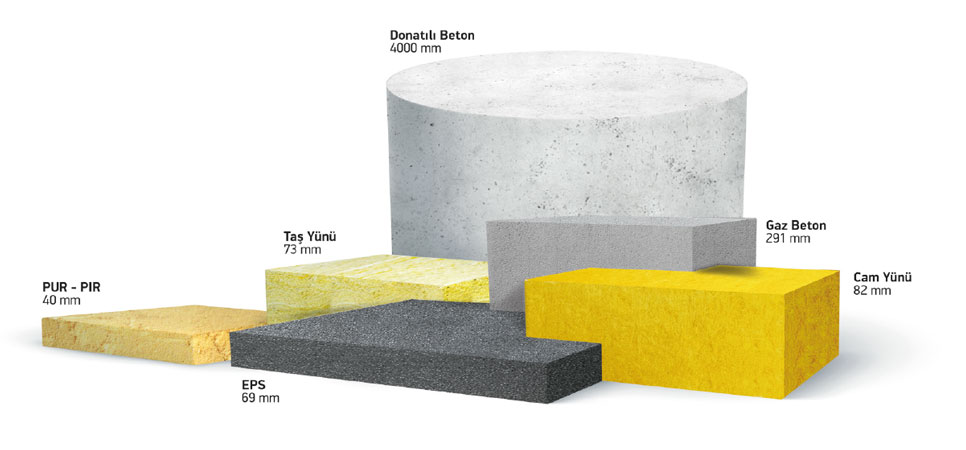
Thermal resistance (R) is the resistance that a building material shows against heat transfer. The higher the R value, the better the material insulates heat. Below is a comparison of the thicknesses of different construction materials with the same thermal resistance.